
A Beautiful New Roof
Built to Protect Your Home for Years to Come
Replace your aging or storm-damaged roof with expert installation from a trusted contractor serving Chicagoland since 2007, with in-house certified crews.
We handle storm damage insurance claims start to finish and back the work with manufacturer-certified warranty options.




See If My Roof Has Storm Damage
Free storm damage inspection or a no-pressure quote for your project
Repair Versus Full Replacement: How to Tell the Difference
Not every roof problem in Chicago ends in a full tear-off, and a good contractor should say so. If a spring hailstorm cracked a dozen shingles on one slope, or a bathroom vent boot dried out and split after fifteen Chicago winters, that’s a repair, not a replacement. The same goes for a skylight that’s leaking around its flashing while the surrounding shingles are still flat, granulated, and gripping the deck. These are isolated failure points, and, if you’re not using your homeowners insurance, patching them typically runs a few hundred to a couple thousand dollars.
Repair Is Likely
- One leak source
- Light storm damage confined to a small area
- Flashing failure around a chimney or skylight
- A handful of missing or cracked shingles
Replacement Is Likely
- Leaks appearing in multiple unrelated rooms
- Decking that feels spongy in several spots
- Hail or severe wind damage across multiple elevations
- Asphalt past 20-25 years, or slate and tile past 40+
The Gray Area
- Hail damage assessments after a major storm
- Cosmetic bruising versus functional damage to the shingle's seal
- Only a hands-on inspection settles which category your roof falls into
A common misconception about flat roofs: on Chicago greystones and two-flats, homeowners assume any wet spot on the ceiling below means the entire membrane needs replacing. In reality, EPDM and TPO systems often develop one failed seam, a punctured area near a roof drain, or ponding water breaking down a small section, while the rest of the membrane remains sound. A qualified roofer can often cut out and patch that section rather than replacing the whole roof, provided the membrane isn’t past its typical 20-year service window and the insulation underneath hasn’t been saturated.
The safest way to know which category applies is a physical inspection, not a guess from the ground. A roofer should check the attic for daylight or water staining, probe the decking for soft spots, and document the extent of damage with photos before recommending anything. If a contractor pushes for full replacement without walking the roof or explaining specific findings, get a second opinion before signing anything.
Signs Your Roof Has Reached Replacement Age
Quick Summary: Most asphalt shingle roofs in our area are built to last 20 to 25 years, but sun, wind, and Chicago winters wear them down faster than people expect. Curling shingles, bald spots, and granules piling up in the gutters are the clearest signs a roof has aged out of repair territory. Once the deck itself starts to sag or you see daylight through the attic boards, replacement isn’t optional anymore.
Age alone doesn’t tell the whole story. A 15 year old roof that took a bad hailstorm can be in worse shape than a 22 year old roof that’s just tired.
In older suburbs like Arlington Heights, where a lot of homes were built in the 1970s and 80s, we still find original three-tab shingles nearing 30 years old. Those roofs are almost always past the point where repair makes financial sense.
- Shingles curling up at the edges or cupping in the middle
- Bald or bare spots where granules have worn away
- Heavy granule buildup in the gutters after rain
- Visible sagging along the roofline or in the attic deck
- Daylight coming through boards when you check the attic
- Leaks showing up in more than one spot, or after every storm
See two or three of these at once? That’s usually our cue to talk replacement instead of another patch job.


Horizon restoration did a great job in getting our roof claim approved by our insurance. They worked hard to make sure the insurance company covered the cost of the roof and gutters. AJ was always on top of things and kept us informed every step of the way. We recommended them to our family member who also signed with AJ and Horizon Restoration due to how well they managed our project. We would highly recommend them for their roofing expertise, knowledge with insurance companies and over all communication during the project. In addition to this the roof looks great and their team did a great job on the roof and the clean up.

Overall great experience! Julius was fantastic to work with. He was very attentive to all the details and always there to answer questions and get the job done right. Whenever he said he would take care of something, he took care of it. The crew did a fantastic job and the workmanship was top notch. I can not believe how quickly they did a full replacement of our sheathing and roof shingles and still did a high quality job. They left the worksite spotlessly clean. We are getting lots of compliments from our neighbors on how good our roof looks. If you want your roof done right, go with this company.

Paul, thank you so much to you and your entire team for our beautiful new roof. We couldn't have made a better choice. Thank you for all your help with the insurance paperwork and for making the whole process so smooth. We highly recommend Chicago Horizon Restoration Roofing Company to anyone looking for quality work and outstanding service! Pamela & Steve

Horizon Restoration did an amazing job on my roof! Paul was fantastic to work with. Super responsive, most important he was honest and really cared about making sure everything was done right. He made what could have been a stressful process feel easy. The crew was fast, clean and very professional. I’m really happy with the result and would definitely recommend them.

Our sales specialist Ronny was awesome through the whole initial process and quoted me a very reasonable estimate to re-shingle garage roof and repair main roof shingles that blew off from heavy winds. The crew came and did an excellent job in one day and left the area clean as it was before. Will definitely use Horizon again and recommend them to everyone that needs any type of roofing work! -Ignacio
What to Know Before You Hire
A full tear-off is one of the largest exterior investments you will make on your home. The right contractor should understand shingle systems, decking, flashing, ventilation, and water management, and how the whole roof performs together once the old material is gone. Ask these four questions before you sign a contract.
How many full roof replacements have you completed recently?
Ask about projects from the last 12 months—not only a lifetime total—and look for experience with the service and materials your home needs.
Are you trained or certified for the products you install?
Manufacturer requirements vary by roofing system, and an improper tear-off or fastening pattern can void coverage. Ask what training the crew has and how the installation affects both product and workmanship warranties.
Can I see your license and certificate of insurance?
Verify current licensing, general liability, and workers’ compensation coverage before work begins.
Can I speak with recent local customers?
Ask for nearby replacement projects similar to yours. Then review the finished work, or at least read reviews for the type of roof you need installed.
Strong repair reviews do not automatically prove tear-off and full replacement expertise. Look for recent projects that match your materials, roof pitch, home style, and scope.
Get a professional inspection before making a major decision.
Roof damage is often wider than what shows from the ground, and a leak in one room rarely tells the whole story. Ask for photos and a written scope so you can compare replacement recommendations and understand any insurance-related next steps.
We pass our own checklist.
- Roofing & siding experience across major systems
- Licensed, bonded & insured in Illinois
- Local team serving Chicagoland
- Clear written scopes & project documentation
- Workmanship & manufacturer warranty guidance
Or call (773) 993-0998
No pressure, no obligation. Just a straight answer on what your home exterior actually needs.
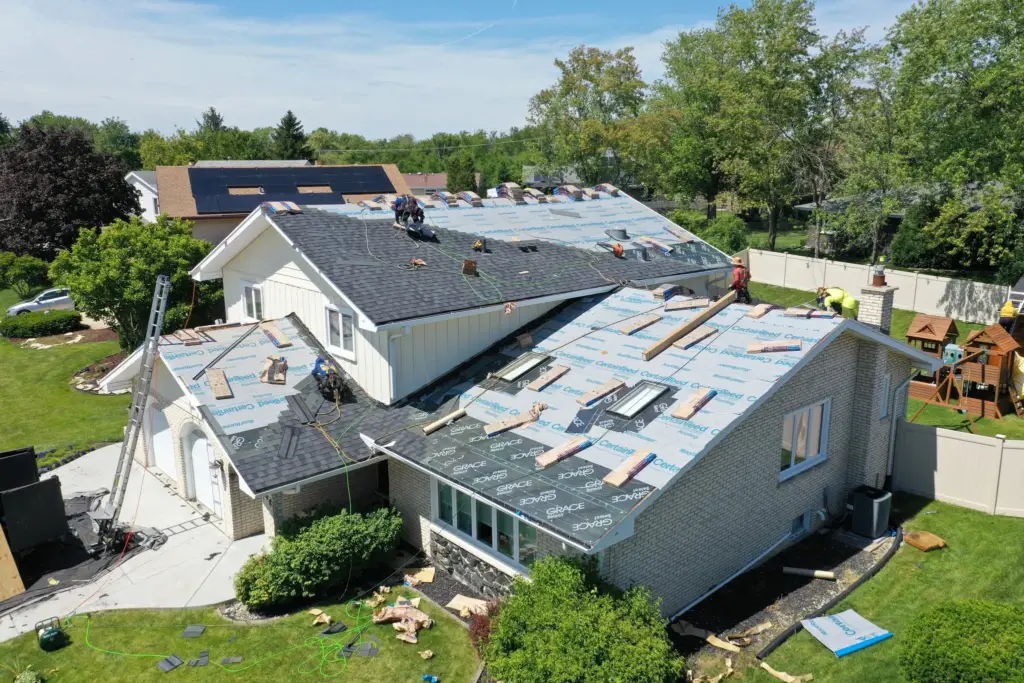
What Happens During Tear-Off and Installation
Tear-off day looks chaotic if you’ve never seen one before. It’s not. Every crew works the same job in the same order, and that order matters more than people think.
We see this every single week: a homeowner asks if their roof will be open to the weather overnight. It won’t. A full tear-off and reinstall on an average Chicago home usually wraps in one day, sometimes two if the deck needs repair or the weather turns.
- Property protection first. We lay tarps over landscaping and set up a dumpster or trailer to catch debris as it comes off.
- Strip to bare decking. Old shingles, underlayment, and flashing all come off, so nothing gets buried or covered up.
- Deck inspection, board by board. Soft, rotted, or water-stained plywood gets replaced before anything new goes down.
- Underlayment and ice-and-water barrier. This matters a lot given how Chicago swings between freeze and thaw.
- Drip edge, flashing, and ventilation. Installed or replaced around chimneys, valleys, and vents.
- New shingles to manufacturer spec. Every nail gets checked for proper depth and placement.
- Cleanup and walk-through. A magnetic sweep for stray nails, a haul-away of debris, and a walk-through with you before we call it done.
On older homes around Naperville and other established suburbs, we run into original plank decking more often than plywood. That changes the repair step, sometimes adding a few hours to the job.
Roof Replacement FAQs
Storm Damage Claims and the Insurance Process
Chicago homeowners deal with more than lake-effect snow and freeze-thaw cycles. The NOAA Storm Prediction Center regularly ranks Illinois among the Midwest states with elevated severe hail activity, and Cook County and its collar counties see multiple hail and high-wind events most storm seasons. A single hailstorm can bruise shingles, crack flashing, and loosen granules across an entire roof slope without leaving obvious signs from the ground, which is why so many roof replacements in the city start with an insurance claim rather than a planned remodel.
Before any tear-off begins, the priority is building a claim that accurately reflects the damage. Insurance adjusters are reviewing dozens of claims after a regional storm, and a rushed or incomplete inspection can result in a lowball settlement or a denied claim that leaves a homeowner covering the full cost of a new roof out of pocket. Taking the preparation stage seriously protects the payout and speeds up the timeline.
01 — Inspection
A trained roofer walks the entire roof system, including slopes, flashing, vents, and gutters, checking for hail bruising, wind-lifted shingles, and granule loss in the downspouts.
02 — Documentation
Photos, measurements, and written notes are compiled into a report that ties specific damage to a specific storm date, matched against local weather records.
03 — Adjuster Meeting
We meet your insurance adjuster on-site to walk the roof together, point out damage that gets missed from a ground-level or drive-by inspection, and answer technical questions.
04 — Approval
Once the adjuster’s report and our documentation align, the insurer issues a claim decision and scope of work, which becomes the basis for the replacement and material selection.
Working with a team that has direct insurance-industry experience makes a measurable difference at every one of these steps. Contractors who understand adjuster terminology, depreciation schedules, and typical carrier scope sheets are better equipped to advocate for a full roof replacement rather than a partial repair when the damage warrants it. We also use a multi-person project review, sending more than one experienced estimator to inspect a damaged roof, so measurements and damage notes are cross-checked before the report ever reaches the insurance company.
Homeowner tip: request a copy of the written inspection report and photos before the adjuster meeting, so any disagreement on scope can be addressed on the spot rather than after the claim is closed.
How Roof Replacement Pricing Works
Roofing contractors, including those following National Roofing Contractors Association (NRCA) conventions, price jobs by the roofing square, a unit equal to 100 square feet of roof surface. A typical Chicago bungalow or two-flat might measure anywhere from 15 to 30 squares depending on footprint and roof design. Every estimate you receive should break down labor and material costs per square so you can compare bids on an apples-to-apples basis rather than a single lump figure.
The per-square rate itself is not fixed. It flexes based on several measurable job conditions that a contractor evaluates during inspection, which is why two homes of identical size can receive very different quotes.
- Tear-off layers. Many Chicago homes built before the 1980s have two or three layers of old shingles or roofing material. Removing multiple layers takes more labor hours and generates more disposal weight than a single-layer tear-off.
- Decking condition. Once old material is stripped, crews inspect the plywood or plank decking underneath. Rot, delamination, or water staining discovered at this stage requires replacement sheathing, which is priced separately from the base roofing scope.
- Roof pitch and complexity. Steep pitches, multiple dormers, valleys, chimneys, and skylights all slow down installation and require additional flashing and safety measures, increasing labor cost per square.
- Material choice. Standard three-tab or architectural asphalt shingles price differently than upgraded impact-resistant shingles, synthetic slate, or metal roofing, each with different material and labor demands.
- Insurance-funded versus out-of-pocket. A storm or hail claim processed through insurance follows adjuster-approved line-item pricing, while a self-funded replacement gives homeowners more flexibility to select materials and scope directly with the contractor.
Chicago’s housing stock adds its own pricing variables. Many older brick homes have low-slope or flat sections over porches and additions that require different materials than the steep-slope shingle areas, meaning a single home may involve two pricing structures on one job. City permit requirements and dumpster placement in tight urban lots can also factor into a contractor’s scheduling and labor allocation, which experienced local crews account for during estimating.
Understanding these cost drivers before requesting quotes helps homeowners ask sharper questions: how many tear-off layers are expected, what happens if decking damage is found, and how the price shifts between insurance and self-pay scenarios. A transparent contractor will walk through each variable rather than presenting a single unexplained total.
Ready to Get Started?
Get a free, photo-documented roof inspection and a written replacement quote. Call (773) 993-0998 today.